
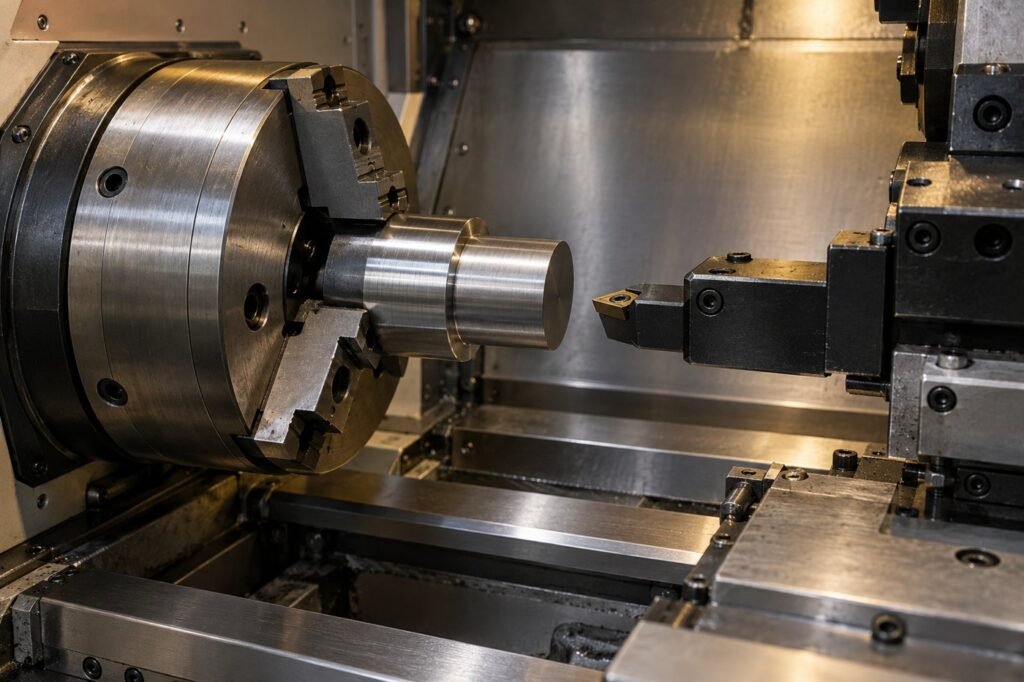
Correct spindle speed and feed rate give a lathe cut a sensible starting point. The calculation is simple, but turning has one important complication: the workpiece diameter changes the surface speed. This guide shows the formulas in inch and metric units, then works through a practical example.
Safety note: calculated values are starting points only. Confirm the cutting speed and feed with the insert or tool manufacturer, and stay within the limits of the lathe, chuck, workholding and setup.
The four inputs you need
- Work diameter: the diameter where the cutting edge is working.
- Cutting speed: surface feet per minute (SFM) or metres per minute (m/min).
- Feed per revolution: inches per revolution (IPR) or millimetres per revolution (mm/rev).
- Machine limit: the safe maximum spindle speed for the complete setup.
Do not guess cutting speed from material alone. Tool material, insert grade, coating, operation, coolant and workpiece condition all matter. Begin with the manufacturer’s recommendation for your exact tool and material group.
Lathe RPM formula in inch units
When cutting speed is given in SFM and diameter is in inches:
RPM = (SFM × 12) ÷ (π × diameter in inches)A common shop-floor version uses 3.82, which is 12 divided by π:
RPM = (SFM × 3.82) ÷ diameter in inchesLathe RPM formula in metric units
When cutting speed is in metres per minute and diameter is in millimetres:
RPM = (cutting speed in m/min × 1,000) ÷ (π × diameter in mm)Feed rate formula
Turning feed is normally programmed per spindle revolution. To calculate the linear feed rate:
Feed per minute = RPM × feed per revolutionIf RPM is 500 and feed is 0.008 IPR, the tool advances 4 inches per minute. In metric, 500 RPM at 0.20 mm/rev equals 100 mm/min.
Worked example: turning a 2-inch steel bar
Suppose the toolmaker recommends 200 SFM and 0.008 IPR for the selected insert and operation. The current work diameter is 2.000 inches.
| Input | Value |
|---|---|
| Diameter | 2.000 in |
| Cutting speed | 200 SFM |
| Feed per revolution | 0.008 IPR |
Step 1 — RPM: (200 × 3.82) ÷ 2.000 = 382 RPM.
Step 2 — feed rate: 382 × 0.008 = 3.056 IPM, which can be rounded to 3.06 IPM for reference.
Enter the same values in the CNC TrueCut lathe calculator to check the arithmetic. Then compare the result with the toolmaker’s data and the available spindle-speed steps or control settings.
Why diameter matters during facing
At a fixed RPM, surface speed falls as the tool approaches the centre of a facing cut. CNC lathes can compensate with constant surface speed mode, commonly programmed with G96. The spindle accelerates as diameter decreases. That makes a maximum-RPM limit essential; many controls use G50 for this limit, but you must verify the correct command and behavior in your machine manual.
G97 commonly selects a fixed spindle speed. Fixed RPM can be appropriate for operations where changing speed is undesirable, but the correct mode depends on the machine, setup and operation.
Adjusting the starting value
- Reduce speed when the setup lacks rigidity, overhang is long, workholding is limited, interrupted cutting is severe or heat is excessive.
- Review feed and depth of cut together. An insert needs an appropriate chip thickness and engagement to work as intended.
- Watch chip control. Long or uncontrolled chips require a safe stop and a review of the insert geometry, feed, depth and cutting conditions.
- Respect the weakest limit. A calculated RPM is never permission to exceed the rating of the chuck, jaws, workpiece, spindle, holder or tool.
Common calculation mistakes
- Mixing millimetres with the inch formula, or inches with the metric formula.
- Using the original stock diameter after the workpiece has been turned smaller.
- Confusing feed per revolution with feed per minute.
- Treating a general material chart as a final recommendation for every tool.
- Ignoring maximum RPM during constant surface speed facing.
Quick checklist before cycle start
- Confirm the units and current cutting diameter.
- Use cutting data for the exact insert, grade and work material.
- Check chuck, jaw, tool, holder and spindle limits.
- Set an appropriate maximum RPM.
- Simulate or single-block where appropriate and perform a controlled prove-out.
- Stop if vibration, chip control, load, sound or finish indicates a problem.
The math is only the first layer. Good lathe parameters combine the formula with reliable manufacturer data, a rigid setup, machine limits and observation during a safe prove-out.
Frequently asked questions
Is lathe feed per revolution the same as feed per minute?
No. Feed per revolution is the distance advanced in one spindle revolution. Feed per minute equals RPM multiplied by feed per revolution. Keep the units and the control’s selected feed mode consistent.
Can I use the original stock diameter for every cut?
Use the diameter where the tool is cutting. At a fixed cutting speed, a smaller diameter requires a higher calculated RPM; the safe machine and workholding limits still apply.
Put the formulas to work
Use our free calculators for speeds, feeds, angles, hole patterns and dimensional checks. For content corrections, contact CNC TrueCut.
Tooling and insert brands: discuss an advertising partnership.