
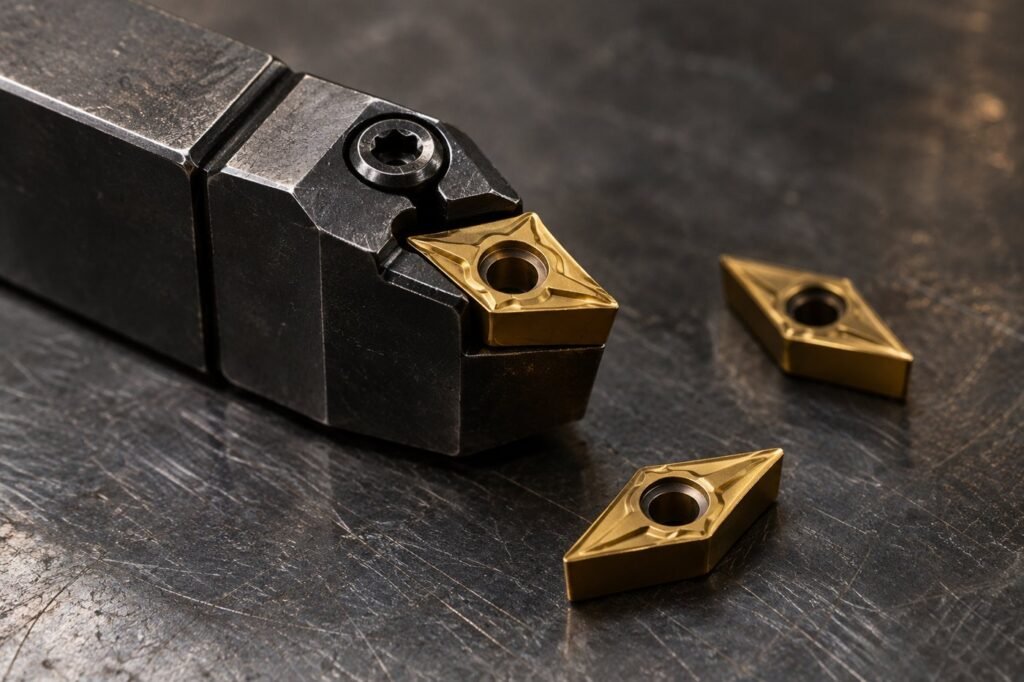
CNMG vs DNMG vs VNMG is a comparison of turning insert shapes: 80°, 55° and 35° diamonds. Start by separating the shape from the application. A CNMG label alone does not say which alloy the insert should cut. Before ordering, identify the holder, the workpiece and the operation.
CNMG vs DNMG vs VNMG: three shapes to compare
CNMG uses an 80° diamond, DNMG a 55° diamond and VNMG a 35° diamond. The narrower point provides more profile access; the broader point offers more corner support. These are shape comparisons, not a promise that one insert will outperform another in your setup.
Read the toolpath before choosing
Mark every surface on the drawing that the tool needs to reach: the outside diameter, shoulder, chamfer, taper and any recessed profile. Then review the holder assembly against that path. A shape that reaches a feature in a sketch may still foul the part once the holder, clamp and neighbouring tools are included.
For an ordinary outside-diameter operation, put CNMG on your comparison list. For profiling, compare DNMG and VNMG against the actual access required. Keep both roughing and finishing passes in the review rather than choosing solely from the finished contour. Confirm the proposed use with the holder and insert manufacturer.
Confirm the complete code
Record the full insert designation, size, thickness, nose radius, chipbreaker and grade. Match the holder pocket, seating arrangement and clamping system. CNMG, DNMG and VNMG are not direct substitutes in one holder. Keep ISO and inch catalogue designations clearly identified when comparing stock from different suppliers.
Add the material decision
Write the exact alloy and condition beside the shape choice. Then open the toolmaker’s selection table for that material, operation and cutting conditions. Compare the grade and chipbreaker as separate fields. A purchase list saying only “CNMG for steel” leaves too much unspecified.
A useful setup record
Create one line for each pass: feature, holder, complete insert code, work material, diameter, speed, feed per revolution and depth of cut. Attach the supplier’s source and record any spindle limit. This makes a later adjustment traceable instead of relying on the appearance of an insert.
Use the turning speed and feed calculator for the arithmetic, then read our material and insert guide to organise selection.
Technical reference: Sandvik Coromant’s turning insert selection guide.
Frequently asked questions
Are CNMG, DNMG and VNMG material grades?
No. They identify insert shape and other geometry features. Choose a compatible grade and chipbreaker separately for the workpiece material and operation.
Can I replace a CNMG insert with a DNMG insert in the same holder?
Do not assume they interchange. Confirm the complete insert code and the holder manufacturer’s compatibility information, including the pocket, clamping arrangement, size and clearance.
Put the formulas to work
Use our free calculators for speeds, feeds, angles, hole patterns and dimensional checks. For content corrections, contact CNC TrueCut.
Tooling and insert brands: discuss an advertising partnership.